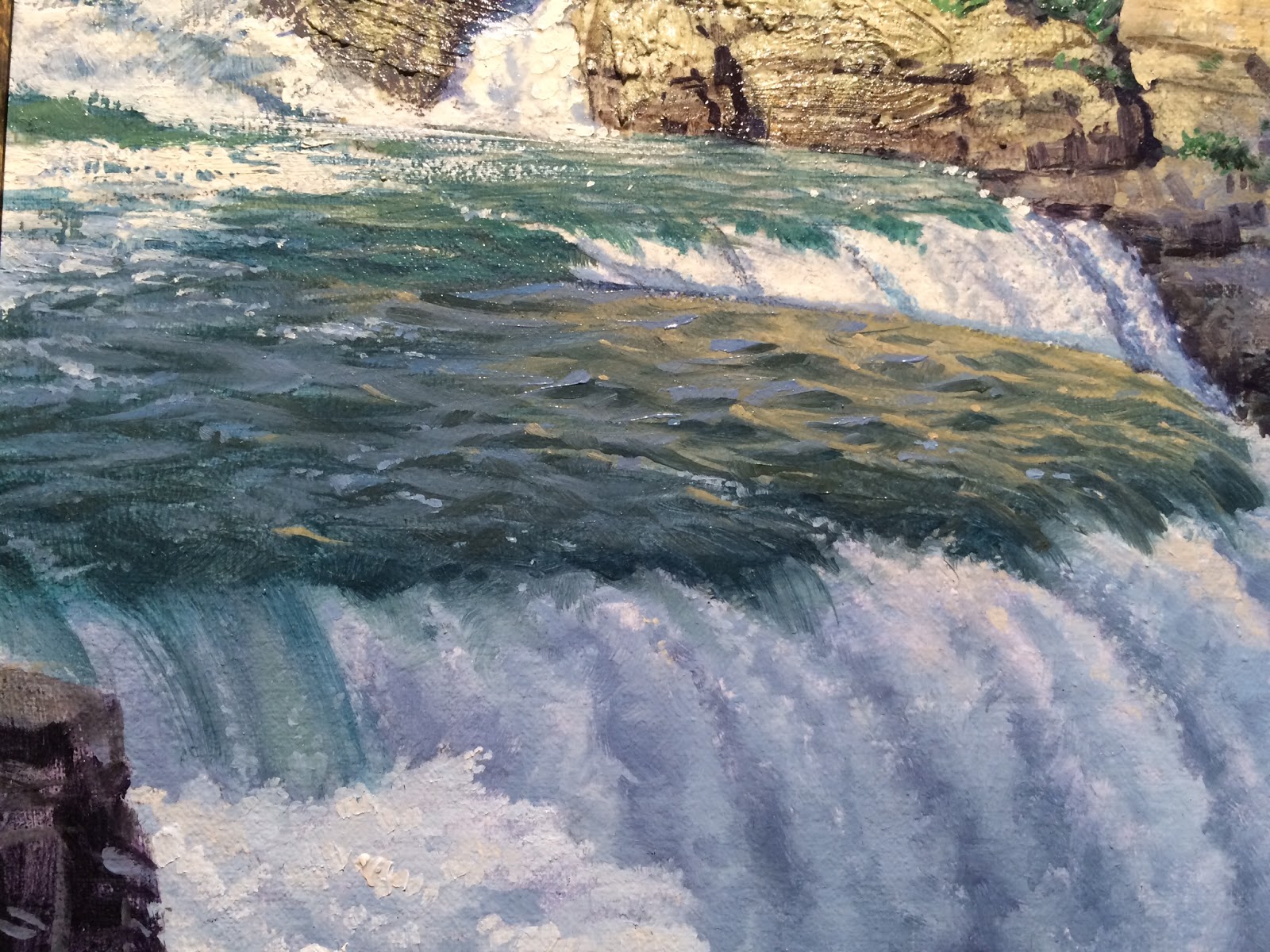
Saturday, October 29, 2016

Hope

"Hope (Eos, Bringer of Light)" Oil on paper on board, 20x16".


Eos is the Goddess of the Dawn. A titan predating the Gods of Olympus, she rises each morning over the great river Oceanus. She lifts the veil of night to bring the light of the new day - to bring Hope.

What does it mean, to have Hope?

It means to have faith that Something Greater is yet to come.

Hope.

It’s a wonderfully human concept, as ancient as man himself.

We are faced with constant stress and duress, we find ourselves in circumstances that are far from ideal. 
We are faced with decisions that place us between a rock and a hard place, with sometimes dire consequences.

What do you do when your fate throws you to the mercy of the wind?
When all that you have, all that you are, goes up in flames?
Do you wither away, resigning to defeat?
What do you do when the air has been sucked from your lungs, and you haven't the strength to stand?
You hold on to hope.

These metaphors can apply to everything that happens.
When fate wants to push you around, you stand your ground.
You plant two feet on the Earth and stand strong, like the rock that withstands the sea's harsh blows day after day.
You look to the skies - to the sun - and draw strength.
And each night - in the cold, in the dark - you hold on to Hope, with faith that the Sun will rise again.
The cycle of night and day is the embodiment of hope itself…that there will always be a new sun on the horizon.
A new beginning.

Hope.


On a Personal Note:
My personal life has been a direct source of thought and emotion behind my paintings for the last eight months, each image serving to document what my thoughts and feelings were at the time of conception. They also serve as a method to cope with those thoughts and emotions - thinking through what I was feeling through the act of painting.
Hope brings me full circle in a few ways.
Hesitance, Resignation, Pursuance, and now Hope are all tied thematically to the idea of Fate, and the outcomes possible when dealing with fate in various ways.
Hesitance and Resignation in many ways embodied a darker side of Fate. Pursuance began to break through those darker emotions, and had under it's dramatic surface a sense of hope and forward thinking.
Finally, Hope brings us face-to-face with the light, literally. I found myself returning to a mindset of hope in my own life, and what better way to illustrate this "return to form" for me than to go back to my roots and love of Greek Mythology?
I began to with Pursuance, that painting being very influenced by the Greek aesthetic and of course the use of a centaur.
But Hope returns to the mythology directly - a portrait of Eos - bringing me back to the series I began with Ares exactly one year ago.

Wednesday, September 28, 2016

Pursuance


"Pursuance" Oil on paper on board, 18x24"

Strength, courage, justice...these are virtues all good men and woman strive for.
The moments we seem to struggle with these virtues tend towards the times of greatest turmoil within our own soul.

The search for clarity and evolution of the soul is often the realm of the mystic and the philosopher alike. It is from these great thinkers that we can gleam a shred of hope; that through introspection and meditation we may come to realize great inner truths that lead us on a path towards virtue.

Our past stays behind us, but it's totality shapes who you are. Do not shy away from those experiences, even those you'd rather not remember.
Look towards the past without apprehension - stare it in the eyes. Glean what you can from your own transgressions. From this you can walk away a better person.

It is on the foundation of our pasts -knowing what has come before to falter and fail, and what has stood the test of time - that we can build ourselves up towards our ideals.

Ambition is an incredibly human trait. It's what can keep us going in the times of greatest struggle, it's what keeps us growing even in times of contentment.

Tempting as it may be, do not look outward for any answers you seek. The greatest power lies within one's self, this you must never doubt.

"Pursuance" detail


"Dreams cover much time,
Still they leave blind
the will to begin.
I searched for you there
And now look for you from within"
-Robert Plant & Allison Kraus

Wednesday, May 25, 2016

Resignation

"Resignation," Oil on illustration board. 24x13.5"


"Res-ig-na-tion: noun
The Acceptance of something undesirable but inevitable."

Fate can be a fickle thing. We like to believe we are meant for something, that we are bound by fate for the trajectory our life takes, or for some greater purpose. That belief tends to be strongest when something positive occurs in our life. We say “it is meant to be”. But when something undesirable occurs in our life, we often find ourselves caught in disbelief. 
We ask ourselves, “How can this be?”, “Why me?” and plead with the skies, “this isn’t supposed to happen!”

Suddenly we don’t want to believe in fate any more.

I don’t particularly believe in a finite, predetermined fate. Rather, I believe in the power of our attitude towards the external forces in our life. Our attitude directly impacts our actions and reactions, and thus, seemingly, our fate. If we accept whatever is thrown at us with grace and dignity, it is neither good nor bad, and it is all “meant to be”.

The Stoic philosopher Marcus Aurelius says in his Meditations, “Misfortune born nobly is good fortune.”


Detail from "Resignation"


My painting “Resignation” is an allegory for this idea of acceptance. The knight is accepting his fate, albeit his ultimate demise. Even though we are with him at the time of his dying, he is at peace. He in fact embraces the nymph - the personification of his fate - accepting it rather than fighting against it. The two are engaged in a gentle and tender embrace, and his right hand even guides the blade. There is sorrow in their eyes, but he bears his misfortune nobly.

For what can we do to stop the power of fate? We are not in control of the external forces in our life. We are only ever in control of ourselves, but there is perhaps an even greater power in that.

Embrace your fate. All of it.

Tuesday, May 3, 2016

Hesitance

"Hesitance," oil on board. 16x20"

"Hesitance" is the first piece in a new body of personal work. In the past, I haven't made a habit of blogging about the meaning behind my paintings, but with this new work I intend to. Aside from being created for my portfolio, it also has a deeper personal meaning, and I feel it deserves a companion blog post.

The past year has been a difficult time in my life, and an overarching theme has been change. I had been resistant to that change until recently, when it came to a head. I was forced to face it. This illustration and several others coming in the next few months deal with the issues I have been facing.

"Hesitance" deals with the concept of stages in life's journey, and subsequently, of change. I chose to use death as a metaphor for change, inspired by Viking funerals. In mythology (and religions for that matter), death is often seen not as an ending, but rather the next phase of one's journey. 

The archer is tasked with sending off a companion to the next phase of their life, and his flaming arrow is prepared to be fired. But he hesitates - he, too, will have to deal with the change brought forth by the absence of that companion. Perhaps he is grappling with the reality of this juncture, or silently saying a final goodbye...

When we are faced with moments of great change we are often hesitant to walk the new path. It seems treacherous - it's unexplored, unknown. Our archer knows he is marking the end of one life - one phase. But perhaps in the end, there can also be found a beginning.

As the sun sets on this day, and a chapter comes to a close, we may make peace under the stars. For in time, the sun will rise again, and the start of a new journey begins. 

Friday, February 5, 2016

Hitting the Ground Running

It's the second month of the New Year, and my first post for 2016 is a news update!
2016 started off with a bang and I've hit the ground running. Momentum is building and I'm excited for what this year could bring. It's going to be a year filled with many firsts for me, so to start, here's what I have coming up so far:

"Ares, God of War" Oil on board, 18x24". September 2015

Publications & Exhibitions:
  • Infected by Art Volume 4:
    • "Ares, God of War" (above) has been accepted into this year's annual fantasy publication! This is a big honor for me and I'm very excited for "Ares" to be my first illustration accepted into a juried competition. Thank you to IBA and the judges!
  • Boris Vallejo & Julie Bell Tribute Exhibition: Opens March 19th, 2016. 
    • "Ares, God of War" was also a finalist in the contest hosted by The Art Order. My painting and a small selection of other finalists will be exhibiting at Gallery Provocateur in Chicago, Illinois.
  • Illuxcon 9 Showcase: October 19-23, 2016.
    • This will be my first exhibition at a convention! I attended Illuxcon 8 in 2015 and can't wait to have a booth this year. Single day, Five day, and Student passes are available at the convention's website.

Website & Social Media Updates:
  • Store: My Etsy shop, which primarily featured oil studies and plein air paintings, has been temporarily removed from my website. A new store with prints and originals of my illustrations is in the works and will be launched in the coming weeks. 
  • Social Media Expansion: In addition to my established presences on Instagram, Facebook, Tumblr, Pinterest, Twitter, and DeviantART, you can now find me on Art Station and Reddit

New Works:
  • I have a few projects under NDA right now that I can't share yet but can't wait to do so! And as always, I'm working to update my portfolio with new works.
  • With Illuxcon 9 coming up in October, I expect to have a new body of work to bring with me to the show.  I'm working on new paintings with the goal of releasing one per month for the next eight months. To finish off this post, here is the first painting of the New Year, "Jason & the Khalkotauroi". Some of you may recognize the image from an older version I painted last year, but that's for another post!

"Jason & the Khalkotauroi" A scene from the Greek Myth, The Argonautika. Oil on board, 20x31".  January 2016.

Wednesday, July 22, 2015

Painting a Gas Station in Gouache

In celebration of his most recent video, Gouache in the Wild, James Gurney hosted a competition to paint a gas station in gouache. The contest was simple: paint a gas station on location (en plein air) using only black & white gouache. The top ten paintings would be featured on Gurney's blog, Gurney Journey, with physical prizes going to a Grand Prize winner and three honorable mentions.

The winners were announced today - and I'm honored to be in the top ten!

My entry for the contest, gouache, 5x8"

The competition was fierce. Established veterans were joining the contest alongside gouache newcomers like myself, and the results speak for themselves. Everyone did a wonderful job, and I must say I'm certainly in great company in the top ten.

After watching Gouache in the Wild, I was intrigued by the medium, which seemed like a mix of qualities I enjoy in both watercolor and oil. The contest was a fun and exciting way to encourage artists from around the world to try out the medium, and it certainly hooked me.

James Gurney says of my entry:


This painting by Nicholas Elias picks up on the weird forms of the superstructure above the pump, with all those fire prevention nozzles.  And it looks like he's got a cool palette rig to hold the sketchbook vertically.”

Many winners provided more information about their entries, so I wanted to share some more info about mine. James picked up on the structures above the pump, but when I first picked the subject, I was actually drawn to the old-fashioned full-service booth joined with a modern gas station. The gas station is a Sunoco right up the street from where I live, and I never noticed how uncommon the booth was until now.

Fittingly enough, as I was painting, the gas station attendent in the booth glared at me suspiciously for the entire two hour session. He seemed particularly bewildered when I first pulled up, sat on my trunk, and started setting up my tripod. But even after a couple of hours, he didn't seem to get used to it. Thankfully he left me alone to paint and didn't ask me to leave.


Posing for a shot on location with the painting nearly complete

James also picked up on my pochade rig, or what little of it was showing in the photo above. Many of you may already be familiar with my oil painting pochade box, custom built out of a cigar box. Modifying the box for painting with gouache was actually very simple. I took the top of an old 24 colored pencil set, turned it upside down, and it just so happened to sit perfectly on top of the removable oil palette in my box. The smooth aluminum surface was perfect for mixing gouache, and makes for easy clean up.


Modified pochade box for gouache

My pochade box already had a shelf that holds 1/8” boards in place, but it was thick enough to hold my sketchbook. In keeping with the spirit of trying new things, I used a watercolor sketchbook recommended by Gurney from Pentallic. The hard covers protect the delicate surface of gouache paintings, and I'm really enjoying the paper's surface with goauche. I have yet to try it with watercolor.


5 minute perspective sketch done in watercolor pencil which dissolved after being painted over.

From set up to clean up I was on location for two and a half hours. This was my second gouache painting ever, and it was already significantly stronger than my first. I'm eager to play with the medium more, and I'm thankful to James Gurney for his video and the contest for introducing me to such a wonderful new medium!

Monday, June 22, 2015

Spending Time with Dinotopia

The weekend before I took a mini road trip to visit the Philadelphia museum, the Brandywine River museum, and the Smithsonian American Art museum, I went to see Dinotopia: The Fantastical Art of James Gurney at the Stamford Museum & Nature Center in Connecticut.

Waterfall City is breathtaking in person! The painting is very large, maybe 5 feet long? (Just a guess!)
I've been an enormous fan of James Gurney ever since I first saw his work in my sophomore year in college. His books, Color & Light and Imaginative Realism are the illustrator's bibles. When I first read through Dinotopia, I couldn't believe what I was seeing! Every page was alive! But I could have never imagined what those paintings would look like in person.

Up close, even in his more tightly rendered paintings, Gurney is somewhat painterly
There were over 50 paintings in the exhibit, each one begging for all of your attention. I had to tear myself away from each painting in order to make sure I got to see them all. The vivacity of the characters, the glow of the paint, the sheer size of them! I never expected so many of Gurney's paintings to be so large!


As I attempted to control my fanaticism and maintain a cool exterior, I was practically drooling over every brush stroke. I filled several pages of my notebook attempting to decipher how Gurney painted each illustration, analyzing as I went along. I filled in the gaps using what I already know about his methods from his videos and books, and from my own experience painting.

I took a couple hundred photos, and as I said there were over 50 paintings in the exhibit. Whittling them down for a few to show a few points for this blog is nearly impossible. But here's my best shot...


Thin, brushy darks glow when you get up close.

Pencil showing through

Gurney's colors are more saturated in person then they appear in print - hence the glow of his paintings in real life. He often paints very thin, to the point where sometimes pencil lines showing through can do some of the detail work for him. (Note: many of his Dinotopia paintings are done in a particular style using oil washes. I'm talking about his more finished, traditional looking oil paintings still retaining some of the thin application)


Gurney paints with a wide variety of edges, allowing soft subtleties here and crisp punches there. Perhaps I'm stating the obvious here, but edge work is something I'm particularly paying attention to lately in my own paintings, so I was really drawn to his use of edges to create depth and focal points. The more I study edges, the more I find that they are really the key to reproducing the way the human eye works, the way we actually see, in order to create a more convincing illusion (in terms of depth, focus, and the actual rendering of a variety of surfaces).

See how it all comes together from a distance? The girl below can be seen here on the bottom left.

Letting the paint do the work!
Particularly, I've been enamored with the ability of masters to leave such unresolved edges at times. I have the tendency to "smooth out"and blend edges in forms that I assume are soft, such as fabrics and skin. However, look at how Gurney leaves a single, hard brush stroke as the highlight on the face above. When you get up close to the painting it stands out, but when you step back (or see the reproductions) it blends in on it's own! Gurney is a master at painting just enough!

Once again, letting the paint do so much of the work & the eye can fill in the rest


Look how crystal clear the foreground elements are to the background crowd
Up close they're nothing more than suggestions of figures!
Gurney is a genius at painting just what needs to be painted, and letting the calligraphy of his brush and the eye of the viewer do the rest. He leaves so much of his illustrations unresolved, just hinting at a person or crowd in the background. A few brush strokes can represent an entire face, a single ambiguous stroke for a hand. He simply saves his crisp edges and values for the punch line of the painting - whatever is important.

One of my absolute favorites. Fell in love with this painting as a reproduction, and seeing it in person made me fall head over heels. What a composition - and the mood! It feels like a lived in world.


This is the tip of the iceberg here. I'm just going to share a few more photos for your own enjoyment and analysis. James Gurney is a living master, so I encourage you to check out his (very inexpensive) educational videos in addition to his books. I've learned a lot from watching him work, and he is a well spoken teacher.


This painting stood out to me because of how Gurney handled such a complex & dense scene. Looks like he almost painted the forest the way he might if he was doing a plein air painting!

You can tell here that he painted very thinly until he hit the opaques mixed with white. Look how simple the foliage behind the T-Rex is!


Monday, June 15, 2015

Spending Time with my Forefathers

Hello again!

It's been quite a while since my last post, longer than I thought. The month of April flew by as I worked tirelessly on the final illustrations for my senior show at the University of Hartford (which was a huge hit by the way!) And I officially have a BFA in Illustration with Magna cum Laude honors!

At the gallery opening with the best professors and mentors I could've asked for, from left to right: Doug Anderson, Dennis Nolan, myself, Bill Thomson

After graduation, I took some time to get my business affairs in order. My three month, six month, one year, year and a half and two year goals are outlined and a calendar has been written. My first wave of postcards and emails have been sent out to potential clients and art reps, and I'm now officially a member of the Society of Children's Book Writers & Illustrators (SCBWI). I moved back to Long Island, and set up my new art studio in the spare bedroom. All in all, a very exciting time for me!

First batch of postcards and tear sheets!
My new studio set up, with some decor that I picked up on my trip.
Of course in the interim I've continued to draw, paint, and look for inspiration, which is where the meat of this week's post lies. I visited a number of museums and exhibits over the past few weeks, and I've got so much to share!

I went on a camping-trip-art-museum-excursion two weekends ago with a number of friends and fellow illustrators. We camped two nights in Pennsylvania and visited the Philadelphia Museum of Art, and the Brandywine River Museum & Wyeth estates in Chadds Ford. The third day we drove down to D.C. to visit the Smithsonian American Art museum.

Sufficed to say in those three short days I was overloaded with information and inspiration, having seen some of the greatest painters from the Renaissance through the Impressionists at the Philadelphia Museum, gawked in the presence of N.C. Wyeth, Andrew Wyeth, and Howard Pyle at the Brandywine River Museum, and sat in awe in front of the masterworks of the Hudson River painters at the Smithsonian.

Couldn't really keep it together seeing this Alma Tadema in person for the first time...I spent a good half hour with this masterpiece, and kept coming back to it whenever I wandered for too long.

My face the entire time at the N.C. Wyeth gallery at the Brandywine River Museum. Here I am with "Crystal Depths," such an incredible painting in person...
Of course a trip like this wouldn't be complete without doing plenty of sketching and painting along the way. We had to do something to let out all of the energy we were absorbing from these paintings!

Did this quick sketch (10 min) of a local at a diner, "Hank's Place," right near the Brandywine River Museum. 

We explored the surrounding fields and park along Brandywine Creek. I stopped to paint these very N.C. Wyeth-esque clouds in the late afternoon. 5x7" oil on canvas board.
Painted this warm sunset peeking over the Creek from the grounds right in front of the Museum. 6x6" oil on canvas board.
And the weekend came to an end! My friends and I sketching passersby from a Starbucks in Chinatown, Washington D.C. 

Last sketch of the trip. This was from our campground at Greenbelt State Park, MD. There was a magical glow in the woods after a rainstorm from the night before.

I'm going to go into more detail for each of the museums over the course of few posts, making a short blog series out of the trip. There is simply too much to share in one post. But for now, I'll leave you with my major takeaways from the trip.

Even the most richly realistic paintings are abstract suggestions - illusions - of what they represent, especially when you view them up close in person. I took almost 2,000 photos over the weekend, mostly detailed views I'd otherwise not find online or in print. Details maybe an inch from the canvas at times, to the point that out of context, that inch or two looks like nothing more than a few abstract strokes of paint - nonsense, really. This was really to remind me afterwards of what painting really is - strokes of pigment suspended in a medium lying flat on a surface.

It was quite eye-opening to see masters such as Coypel, Eakins, Church, Bierdstadt or Moran up close, to see how abstract and textural their paintings really are. Alma Tadema was especially surprising! There wasn't a single painter I saw all weekend whose work was an exception to this revelation. I realized that what realism and representational art boils down to is edge control. It doesn't matter if you hand-paint every crack and surface of stone, or strand of hair, but rather you can allow the qualities of the paint do so much of the work for you. It is really about edge control above all else. Edges allow the eye to read a certain texture, a variety of lost and found edges can bring so much depth to a painting, strengthen the focal point and retain the viewer's interest. And every painter, without fail and regardless of medium, allowed the qualities of the paint itself to do so much of the work.

Most incredible to me was seeing Howard Pyle & N.C. Wyeth's work in person. I was surprised to see how large the illustrations were - and they really came to life in person. They were both very, very loose in handling the paint, but less "stylized" than they appear in print. It looks largely alla prima, and perhaps the speed of painting alla prima was a necessity under the restraints of deadlines.

N.C. Wyeth was especially so rough and loose in unimportant places - just a couple of strokes indicating an entire form at times. I think working large lent itself to working this way as well, because when the paintings reduce down they tighten up. It's a similar affect to simply standing a few feet back from the painting. (I think I may try to work a bit larger on my next illustration, I'll just need to remind myself to step back often). Faces and body language were of the utmost importance in Howard Pyle's work - and as such the faces were the most carefully tended to. Other spots could literally be one stroke. One, carefully placed stroke!

Every masterpiece I saw this weekend was in their own way loose and abstract, but so completely controlled. It was perhaps most evident in Sargent's work in particular. In person, it almost looked like he didn't paint quickly at all, but he simply painted every stroke accurately.

As I said, these are some rather simple major themes from the trip. Over the next week or two I'll go into more depth with some of what I experienced, and post plenty of photos!

Monday, April 6, 2015

Senior Thesis Update

Happy holidays to everyone!
This is going to be a light post this week.
It's April 6th, and I've got exactly 17 days until my senior thesis project is due.
I'm on my final two pieces, and excitement is definitely building as I begin to wrap up the project.
It's been a long, yet incredibly fast couple of months. I've learned so much by being in charge of my own personal project, but that's a post for another time.

My senior illustration class is putting on a gallery show to showcase all of our thesis projects. The show is at the Joseloff Gallery, on campus, at the University of Hartford. The opening reception is on Saturday, May 2nd, from 5-7pm. It's shaping up to be a great event! There will be food and live music, and we will be sending out postcards to local and regional art directors and publishers, inviting them to attend. Everyone is welcome, so if you're in the area please join us!

In order to fund all of this, we've set up an Indiegogo campaign that I mentioned in last week's post. There's only two days left! At the time of writing, we've raised $300, about half of our goal! Thank you to all who have donated so far, and I ask all readers to please consider donating even just a dollar. Every dollar helps!

If you can, please donate here.

I've been updating my website, Facebook, Instagram, DeviantART, Pinterest, Twitter, and Tumblr with all of my senior thesis pieces as they are completed.

And to wrap up, here is a great quote by Jeremiah Patterson:

“Creativity comes from creation”

Monday, March 30, 2015

Sicily, Part Five

Before we get into this week's post, I have a special announcement!
My senior class at the University of Hartford is having a gallery show on May 2nd to showcase all of our thesis projects. We are having the show on campus in the Joseloff Gallery, a privately owned gallery. Putting up a show requires a lot of effort and funding.
We have set up an Indiegogo, and are now accepting any and all donations for the next week! Everything helps, so if you can, please make a donation here.
Thank you in advance!
And if you are in the area, please join us for the opening reception of the show on Saturday, May 2nd, from 5-7pm at the University of Hartford.


Now for this week's post, the finale in my Sicily series:

On our last bus ride to the airport from Taormina, our tour guide Rosa gave one last history lesson. This time she spoke about the creation myth of the island itself. I tried to take notes while listening, but I was enraptured in Rosa's telling of the story, the Trinacria. I'll summarize as best I can:

Three Nymphs were misbehaving (as nymphs often do) and Athena called them to Mount Olympus. There, they were Zeus' prisoners, awaiting their judgement by the God.
Zeus forgot they were there, and many years passed as they waited patiently to hear their fate.

One night, the Nymphs overheard three other gods discussing who among them was the greater god. Each beheld what they were the god of; one of soil, one of fruit, and one of flowers, and they argued why each was the greatest.

The next day, the Nymphs could think of nothing but holding soil, fruit, and flowers in their hands. They longed to see Earth again!

They waited until night, and while Zeus was asleep, the Nymphs decided to sneak out of Mount Olympus to gather a sample of each of the items, with the intent to bring it back to Olympus.
The Nymphs took with them a basket and descended to Earth, where they gathered the three samples.

But they lingered on Earth for too long! Dawn was coming and with it, Apollo, lifting the veil of night. As the Nymphs flew towards Olympus, they crashed into Apollo, where the three of them fell into the ocean, dropping the basket and all it's contents in the middle of them.
Zeus, becoming aware of their transgressions, was furious! He took from the Nymphs the life from their lungs and they sank where the fell to the bottom of the ocean.

Athena deemed this action too harsh, and so breathed life back into them. Instead, using the contents the Nymphs had gathered, Athena turned them into an island. The Nymphs were reborn as the island of Sicily, and the three corners of the island were where each of the Nymphs fell.

I am of Greek and Sicilian descent, though I've always been very connected to my Greek heritage in particular. However, being in Sicily led me to a sense of belonging, a sense of an ancestral home, and that feeling was more powerful than I had anticipated it to be. I was fascinated to learn how much Greek history shaped Sicily, originally known as "Magna Graecia," or Greater Greece. After learning of Trinacria, I knew I had to illustrate the mythos as a reflection of my time in Sicily, and a celebration of my heritage.


Rather than illustrating a single moment in the story, I chose to take a more allegorical approach. The composition was designed with the shape of Sicily in mind. If you lay over a map of the island, the positions of the three Nymphs correlate to the three corners of the island, as they do in the story.

Each of the Nymphs holds one of the objects they were collecting; soil, flowers, and fruit, and one Nymph holds the basket. Inside of the basket, I chose three fruits (well, two fruits and one vegetable) that are staples in Sicilian culture, and were a large part of my culinary experience there; grapes, blood oranges, and artichoke. Finally, the lighting is of course the break of dawn with a low, golden sun casting long shadows, indicative of Apollo's coming. The basket is positioned in between all three figures, and all elements of the piece hint towards the immediate fate of the Nymphs; the birth of Sicily.


I hope you've enjoyed my posts the past month, as I've enjoyed recollecting the experience.

Monday, March 23, 2015

Sicily, Part Four

This week on the blog is Part Four in my series recalling my experience in Sicily last year. If you haven't already, read parts onetwo and three first!


Color sketch of Ionian sea from Taormina, sketch of Trinacria, symbol of Sicily

"3/23/14 7:20 am
Last morning here in Sicily.
The sun rose over the Ionian sea today, casting an orange glow on the water. I'll never forget the colors of this place. Mt. Etna always has a belt of fog at it's base, just above the coast line. And the colors of the ocean! I'm looking at them right now from the balcony in the hotel. Bluegreens, viridian, the purest light cool blue, and a summer of white on top of it all. It's paradise. I'm sad to leave, knowing what's back home.
Stressful school work, mind-numbing distractions, and the lack of this beautiful island."

3 Legged woman, symbol of Sicily - Trinacria
-Head of Medusa, thrown into center of Sicily to protect it by Athena
-3 Legs = 3 corners of Sicily, 3 Nymphs w/ Basket of fruit, soil & flowers
-Greek Symbol, 2800 years old (Naxos 2800 years old, 1st settlement)
-Birth of Sicily - basket & Nymphs fell into ocean, Zeus made an island
-Messina, Syracusa, Palermo 3 major cities at corners where 'knees' bend

This trip is perhaps the greatest experience of my life in so many ways."

On our last bus ride to the airport from Taormina, our tour guide Rosa gave one last history lesson. This time she spoke about the creation myth of the island itself. I tried to take notes while listening, but I was enraptured in Rosa's telling of the story, the Trinacria. I'll expand on the Trinacria next week as my final post about Sicily.

Finally, I'd like to share with you my final writings from Sicily, my reflection from the plane ride back to the U.S.

"3/23/14
On the plane from Rome to Boston.
I just looked through this book. It's incredible how vividly a memory can come to you from journaling and sketching. With each page I would remember the exact moments I drew something or wrote something down. I could remember the sights, the smells, the sun on my skin, the tastes, the feeling of the place, and my own emotions in that moment.
I've been a student of art for my entire life, but never have I kept a sketchbook and journal like this. I've talked about needing to sketch more, but never have I had a book in my pocket the way I have had the past ten days.
I've become attached to this book already. Sicily was the spark I needed to force myself to journal, and now I want to bring that home. Regardless of the monotony of daily life in Connecticut or New York, or the comparatively boring scenery, there is beauty everywhere.

If there is one thing I can take away from this trip, it's that beauty does not only exist in vast mountains and oceans, sprawling archaic cityscapes, or in grandeur. It also exists in every tiny moment that make up those larger than life scenes.
It exists in the rusted iron door knockers on a weather beaten green door, in the shimmer of light on a cobble stone street. It exists in the moments when a complete stranger says, "Buon giorno!" to an American abroad.
It exists when the sun shines just the right way, illuminating a potted plant on a balcony above you.
Beauty exists when you wake up to the sun rise poring through the window, rather than a beeping alarm.
It exists in the sound of waves and smell of salty air, in the taste of wine and sounds of laughter with good company.
Beauty exists in solitude, exploring every nook and cranny of an olive oil estate, in the moments when the sea's colors beckon you to wade out & touch them all.

Beauty is everywhere, you need only to look.
And it's in those small moments that the sudden need to capture it in writing or drawing or painting arises, and a book in your pocket becomes a necessity.
I've never felt more connected to my pen or pencil, and I've never been able to see so well. Regardless of whether or not I spent 5 minutes or 50 minutes on a sketch, however loose or tight it ends up, it's in the seeing that matters. By looking at something and attempting to draw it, you take it in in a different way. It forces a slower pace, and opens up a greater appreciation.

I can recall the first semester I was an art student in HAS, after switching from Hartt (I was a music major for the first two & a half years of college). That was just one year ago. I recall the feeling of being able to look up, look around me and appreciate the visual sights as opposed to being locked up in a practice room all day. Art requires looking, experiencing, traveling, it all goes into your visual bank. Traveling to Sicily takes that feeling from a year ago and expands it a hundred fold. I feel reinvigorated, and humbled.

Returning home, I will keep this journal in my pocket as I have the past ten days, as I still have half of it left to fill. Once full, I will continue journaling, sketching, writing and painting. It will keep me humble, force me to think of the basics of visual communication, and help me to keep my eyes up and open. It will keep my love and appreciation for art alive. 

Painting is more than a job, or career, so much infinitely more. It is something intangibly personal and therapeutic. There is nothing else like it. There is a stillness in motion, as I recalled on the third day in Sicily while I sat by the ocean. But as I sit here now reflecting on art, those same words apply to painting. While painting, there is a peace and calm in the heart, even if there are moments of stress.

My final thoughts before wrapping up this trip have to do with distraction. Traveling and journaling, keeping my eyes open, waking up at sunrise and enjoying that sunrise before starting my day, spending my free time exploring, thinking, writing and drawings, leads to a sense of accomplishment and fulfillment at the end of a day. I didn't have a phone, computer or any device with me for the past ten days. I noticed within a single day how much more in tune with myself I felt, how much better I slept, how much more human I felt!

I'm as guilty as anyone else in my generation for being addicted and dependent on phones, computers, internet, etc. But a ten day complete break from it all was incredibly powerful for me. I often complain about not having enough time in the day to work, but how many hours are wasted on my laptop? I depend on TV shows for "down time" and relaxation. After this trip there is a clear distinction between relaxation and distraction. Relaxation is healthy for the mind, you clear your thoughts, settle your emotions, and regain balance. Distraction simply pushes all of that into the back of your mind, bottling up everything, and never balancing anything. Well no more, not for me. No more distractions. I want to paint!

It is those distractions that detract from our humanity. All of the beauty around us goes unnoticed because we keep our heads down in our own personal worlds where we are the center. Not the Sicilians! They look up and say hello. They make everything around them a work of art. They are warm and kind, inviting strangers into their homes. It is unlike anything I've ever witnessed.

All of the hours spent on the internet, watching TV and movies, texting, etc could be so much better spent! Taking a walk just because, with no where to go, head up and taking in your surroundings. Bettering yourself as a person, or as an artist. Both!

On this trip, even if I wasn't drawing or painting, I sat somewhere and looked. I would take a walk, and better yet I'd do with friends. I'll repeat something I've already written:

I feel human.

It is a combination of the incredible experience, traveling around Sicily, learning what I have learned, as well as the lack of distractions that sort of gave me a new breath of life. I don't want to go home because I don't want to leave Sicily. I don't want to leave the beautiful place, nor the experience of the place. I know old habits of distraction, stress, etc, wait for me back home. But I know it's on me now to bring Sicily home with me. To take all I've learned and continue to push myself and learn more. 

One of the greatest things said this entire trip sums it up; as Jeremiah related a quote by Jack Beal in the Greek theater at Taormina:

'Make your art like your life and your life like your art.'"

One year later, I can say that I did take Sicily home with me in so many ways. I've kept a journal & sketchbook with me at all times, and I spent last summer focused on plein air painting. After my thesis project is complete in May, I intend to return to plein air painting. I've let go of so many distractions, and spend my days filling my time with art, books, and experiences in their stead. At the end of the day, my goal is to go to sleep feeling accomplished and fulfilled. It is far more rewarding than anything one may gleam from distractions.

One year later, I can say that Sicily changed so much in my life, from the way it inspired and still inspires me artistically, to the way it changed my approach to every day. The lessons learned in those ten days will inform me indefinitely, and I am forever grateful for the opportunity to have had that experience.

Next week will conclude my Sicily series. I will write about the illustration I painted as a reflection of my time in Sicily. 

Also, I will repeat the public announcement made on last week's post:
I've been expanding my social media presence! In addition to this blog, my websiteFacebook, and deviantART, you can now find me on TwitterInstagramPinterest, and Tumblr!
All of the profiles feature my current portfolio, and I've begun to post unique content to each as well. Over time, the unique content will continue to grow, so be sure to follow me on your favorite platform. Thanks!